· Updated
How to Protect and Display Graded Cards
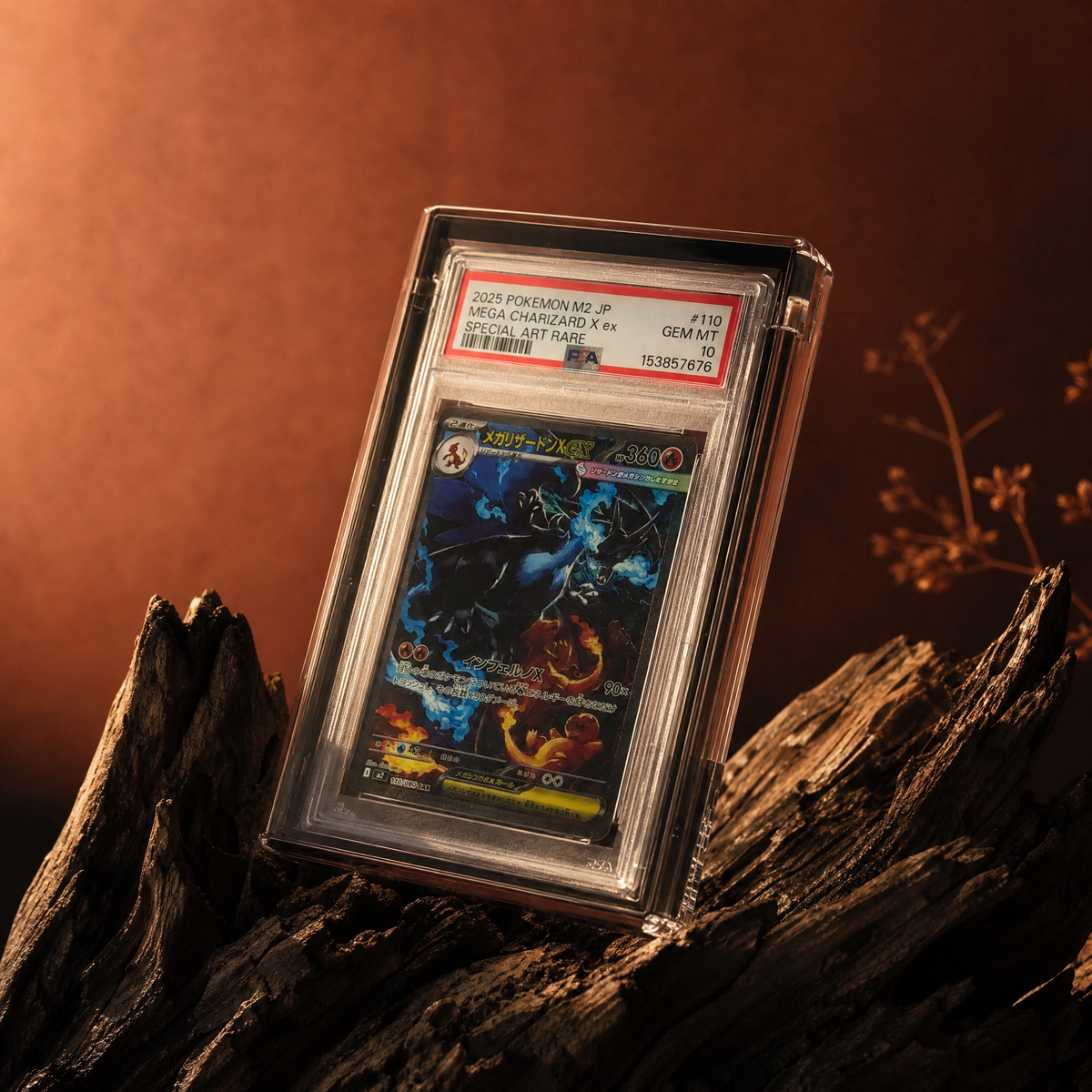
A graded slab does a lot: it seals the card, locks in the grade and survives everyday handling. What it doesn’t do on its own is stop the slab face scuffing, the corners chipping when it’s knocked over, or light slowly fading a card on display. This guide covers what actually causes the damage, what each type of protection does (and doesn’t) do, and how to display graded cards so they look the same in ten years.
What actually damages a slabbed card
- Scratches and scuffs. Slab plastic marks with handling, stacking and sliding across shelves, and a hazy slab face makes even a PSA 10 look tired.
- Knocks and drops. Corners and edges take the impact when a slab is dropped or tipped over.
- Light. This is the one people underestimate. Light damage is cumulative (a little light over a long time does the same harm as a lot over a short time) and it can’t be undone. Museums treat it as permanent, which is why galleries keep light levels low.
UV gets most of the attention, but it isn’t the whole story. The Canadian Conservation Institute notes that for light-sensitive colours, visible light often does more of the fading than UV, so even perfect UV filtering slows fading rather than stopping it. Printed inks, coloured borders and dyed card stock are exactly the materials most at risk.
Do PSA slabs block UV?
It depends on which holder, and nobody publishes a number.
- In 2014, PSA customer service told a collector that its holders were not UV protected (shared on the Elite Fourum).
- When PSA launched its new holder in May 2024, it described it as highly impermeable to UV light, but it didn’t give a UV-blocking percentage.
- TAG says its slabs use UV-rated acrylic, again without a percentage.
Without a published figure from any grader, the safe assumption is that a slab is not a UV filter. If a slab will sit on a shelf or a desk, add a layer that is rated for UV and keep it out of direct sun.
What a “99% UV” claim actually means
Ordinary acrylic and glass block some UV, but how much varies widely, and standard sheet often lets a good share of long-wave UVA through. Specialist UV-filtering acrylic is made to absorb far more. Museum-grade framing acrylic, for example, is rated to block 99% of UV from 300 to 380 nm. That range matters: a percentage only means something if you know which wavelengths it covers, so two products can both say “UV protection” and perform very differently.
Card Guard acrylic is rated at 99.95% UV protection. Even so, the advice below still applies: UV filtering slows fading, it doesn’t make a card immune to light.
Bumpers, sleeves, acrylic cases and magnetic holders compared
| Option | What it protects against | What it doesn’t | Typical AU price |
|---|---|---|---|
| Bare slab | Pressure and most handling damage to the card | Scratches to the slab face; no stated UV protection | n/a |
| Slab sleeve | Dust and light scratches | Knocks, drops and UV | About $8–$11 per 100 |
| Rubber or TPU bumper (“slab guard”) | Knocks to the edges and corners; scuffs | The front and back stay exposed; no UV protection | About $4–$12 each |
| Acrylic slab case | Scratches, dust and edge knocks; UV only if the acrylic is UV-rated | Many don’t state their UV rating or inside depth, so the fit and protection vary | About $10–$60 each |
| Aluminium and glass magnetic case | Edges, faces and scratches | UV claims rarely come with a figure | About $35–$45 each |
| Magnetic one-touch holder | Raw (ungraded) cards | Not made for slabs | About $4–$5 each |
Prices are typical Australian retail prices seen in October 2026 and will vary.
A quick word on bumpers: many acrylic cases on the market are made to hold a slab with its bumper on. Card Guards aren’t. Each one is cut to the bare slab, so a bumpered slab won’t go inside. The acrylic replaces the bumper rather than covering it.
How to display graded cards
- Keep them out of direct sun. Never display slabs in or near a window. Hobbyist window tests have shown visible fading in months, even in standard slabs.
- Use LED lighting. LEDs give off very little UV compared with daylight.
- Keep the light low. Museums keep light-sensitive paper items at around 50 lux. Your shelf doesn’t need to be that dim, but less light means slower fading.
- Rotate your display. Swap your grails in and out every few months so no single card takes all the light.
- Stand slabs upright, don’t stack them loose. Stacking and sliding scuff slab faces; a fitted case and a stand avoid both.
- Store the rest in the dark. Slabs that aren’t on display are safest boxed, upright and away from heat and damp.
Where Card Guard fits
Card Guards are precision-cut acrylic cases for PSA and BGS slabs: 8 mm deep inside for PSA slab cases and 10 mm for BGS slab cases, with 99.95% UV protection and the label and cert number on full view. Choose clear to let the card do the work, or black to frame it. Not sure which slab you have? See our PSA and BGS slab size guide.
Frequently asked questions
Will a PSA slab fade in the sun?
The card inside can. Light damage is cumulative and permanent, and PSA doesn’t publish a UV rating for its holders, so keep slabs out of direct sunlight and use UV-rated protection on display.
Is a bumper or an acrylic case better?
A bumper protects edges from knocks but leaves both faces exposed. A fitted acrylic case covers the faces and edges, and a UV-rated one also filters light.
Do LED lights fade cards?
Much less than daylight, because LEDs emit very little UV. All light fades sensitive inks eventually, so lower light and rotation still help.
Sources
- Library of Congress, “Light”: loc.gov
- Canadian Conservation Institute, “Agent of deterioration: light, ultraviolet and infrared”: canada.ca
- Museums & Galleries of NSW, “Light damage and light control”: mgnsw.org.au
- PSA, “Meet the New Standard”, the May 2024 holder: psacard.com
- TAG, “Are TAG slabs UV resistant?”: help.taggrading.com
- Elite Fourum, “Are PSA slabs 100% UV protected?”: elitefourum.com
- Tru Vue, Optium Museum Acrylic (UV rating and wavelength range): tru-vue.com